

When writing a professional email, even a small detail such as the capitalization of an email sign-off can make you pause. One of the most common questions people ask is, is best regards capitalized? The phrase “Best regards” appears in countless professional emails, business letters, job applications, client messages, and workplace conversations. Because it is so common, many people assume there is only one correct way to write it, while others are unsure whether both words should begin with capital letters. Understanding the correct style can help your emails look polished, professional, and consistent.
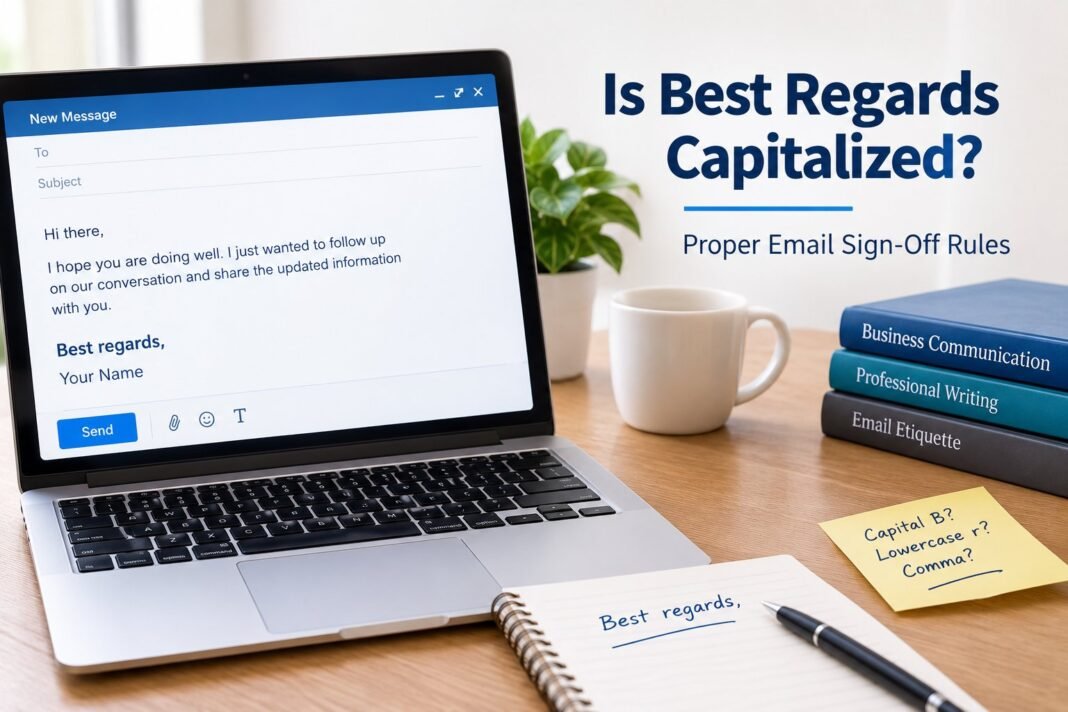
The standard form is generally “Best regards,” with a capital B in “Best” and a lowercase r in “regards.” The comma is also commonly used after the closing. Although you may occasionally see “Best Regards” with both words capitalized, this is generally a matter of style rather than a serious grammatical mistake. The important point is to understand conventional business-writing practices and use them consistently.
“Best regards” is known as a complimentary close or complimentary closing. It appears near the end of a letter or email, immediately before the sender’s name. Its purpose is to provide a polite and professional ending to the communication. The phrase has a neutral-to-warm tone, which makes it useful in many professional situations. It is formal enough for business communication while still sounding friendly and approachable.
Knowing how to capitalize this phrase is especially useful when you are communicating with employers, clients, coworkers, customers, teachers, business partners, or professional contacts. A correctly formatted closing may seem like a minor detail, but attention to small details can contribute to a more professional impression. Therefore, understanding whether best regards should be capitalized is a useful part of learning professional email etiquette.
Is Best Regards Capitalized?
The usual answer to the question is best regards capitalized is yes, but only the first word is normally capitalized. The conventional form is “Best regards”, not “Best Regards.” The first word, “Best,” begins with a capital letter because it starts the complimentary closing. The second word, “regards,” normally remains lowercase because it is part of the same closing phrase rather than a separate title or heading.
This follows a common capitalization pattern used in complimentary closes. When a closing contains multiple words, the first word is typically capitalized while subsequent words are generally written in lowercase unless they are proper nouns or another specific capitalization rule applies. As a result, “Best regards” follows the same general principle.
The distinction can look small on the page, but professional writing often depends on these small conventions. When you use a standard format, the reader can immediately recognize the phrase as an email closing. It also makes your writing appear more natural because the format matches what readers commonly encounter in professional correspondence.
It is worth noting that capitalization conventions can differ between organizations, industries, and style guides. Some people capitalize both words in email sign-offs, particularly because they treat the closing almost like a heading or a standalone phrase. However, the more conventional business-writing style is to capitalize only the first word.
Therefore, if you want a safe and widely accepted format, use “Best regards,” rather than “Best Regards,”. This approach is appropriate for most professional emails and business correspondence.
What Is the Correct Way to Write “Best Regards”?
The preferred professional form is “Best regards,” with a capital B, lowercase r, and usually a comma at the end. The closing should normally appear on a separate line near the end of the email, followed by the sender’s name on the next line.
The reason “Best” is capitalized is straightforward: it is the first word of the complimentary close. “Regards” is not normally capitalized because it is the second word in the phrase. This is similar to the capitalization used in many other multi-word complimentary closings.
The comma after “Best regards” is widely used in traditional business correspondence and modern professional emails. Some formatting styles may omit the comma, particularly in certain contemporary email styles, but including it is a safe and conventional choice. If your workplace or organization follows a particular style guide, it is best to follow that established convention.
The most important thing is consistency. If you use a particular capitalization and punctuation style throughout your professional communication, your writing will look more intentional and polished. Constantly switching between “Best regards,” “Best Regards,” and “best regards” can make your correspondence look less consistent.
A professional email closing does not need to be complicated. The purpose is simply to finish the message politely and transition naturally to your name and contact information. “Best regards” works well because it communicates goodwill without sounding excessively formal or overly personal.
Why Is “Best Regards” Commonly Used in Emails?
“Best regards” has become one of the most popular professional email sign-offs because it occupies a useful middle ground between formal and informal communication. Some closings can sound extremely formal, while others may be too casual for a business environment. “Best regards” generally avoids both extremes.
The phrase communicates respect and goodwill toward the recipient. It does not necessarily imply a close personal relationship, which makes it suitable for communication with people you know professionally but may not know personally. This versatility is one reason it appears frequently in workplace emails.
Another advantage is that the phrase is relatively neutral. You can use it when requesting information, following up on a conversation, communicating with a customer, responding to a colleague, or maintaining a professional relationship. Its meaning is polite without requiring a strong emotional tone.
“Best regards” is also useful when you want to sound friendly while maintaining professional boundaries. In many workplaces, communication needs to be respectful but not excessively formal. A sign-off such as this can help create that balance.
Over time, the phrase has become so familiar that readers usually do not interpret it literally as a detailed expression of personal sentiment. Instead, they recognize it as a conventional professional closing. This makes it easy to use without adding unnecessary emotional weight to the email.
Is “Best Regards” Wrong?
Writing “Best Regards” with both words capitalized is not usually considered a major grammatical error. It is more accurately described as a capitalization-style issue. Many people use this format, and readers will understand the intended meaning immediately. However, if you are trying to follow conventional professional writing standards, “Best regards” is generally the better choice. Capitalizing both words can make the closing look more like a title or heading. In standard sentence-style capitalization, only the first word is normally capitalized.
This distinction is important because professional writing is not always about identifying something as absolutely right or wrong. Many writing conventions are based on established style preferences. Different organizations may have different preferences, and some businesses may use title-style capitalization throughout their email templates. If you are unsure what style to follow, sentence-style capitalization is the safest option. It is simple, widely recognized, and unlikely to attract negative attention. Using “Best regards,” demonstrates familiarity with common professional correspondence conventions.
Ultimately, the quality of an email depends much more on clarity, relevance, tone, grammar, and professionalism than on one capital letter. Still, using conventional capitalization helps eliminate unnecessary distractions and gives your communication a polished appearance.
Should You Put a Comma After “Best Regards”?
In traditional professional correspondence, a comma is commonly placed after the complimentary close. Therefore, “Best regards,” is a widely accepted format. The comma separates the closing from the sender’s name and follows established correspondence conventions. Modern email writing can be somewhat flexible about punctuation. Some people leave out the comma in their email signature because they prefer a minimalist format. Others follow traditional business-letter punctuation and always include it. Neither approach is likely to cause serious confusion, but consistency is important.
If you are writing a formal business email and do not have a specific company style to follow, including the comma is a reliable choice. It gives the closing a conventional appearance and works well across most professional situations. Punctuation can also influence how an email feels visually. A properly formatted closing creates a clear transition between the main message and the sender’s name. When the sign-off is separated cleanly, the reader can easily identify where the message ends.
The same principle applies to other complimentary closes. Whatever closing you choose, it should be formatted consistently with the rest of your professional communication. Your goal is not to make the closing visually complicated but to make it clear, natural, and professional.
Is “Best Regards” Professional?
Yes, “Best regards” is widely considered a professional email sign-off. It is appropriate for many workplace situations because it communicates politeness without being excessively formal. Its balanced tone makes it suitable for communication between colleagues, clients, customers, managers, employees, and other professional contacts. One reason it works so well is that it does not assume a particular level of familiarity. You can use it when communicating with someone you know well professionally, but it can also work when contacting someone for the first time. The phrase does not sound as distant as some highly formal closings, but it also does not sound overly casual.
Professionalism in an email is determined by more than the closing, of course. The body of the message should be clear, respectful, grammatically sound, and appropriate for the recipient. A professional sign-off cannot compensate for an unclear or discourteous message. Still, the closing contributes to the overall impression. Ending a message with “Best regards” gives the recipient a clear signal that the communication is intended to remain courteous and professional.
Is “Best Regards” Formal or Informal?
“Best regards” is generally considered professional and moderately formal. It is not as formal as some traditional business-letter closings, but it is more professional than casual expressions commonly used with friends or close acquaintances. The exact tone depends on the context. In a formal corporate environment, “Best regards” may feel relatively relaxed. In a casual workplace, it may feel more formal than necessary. This flexibility is one of its biggest strengths.
The relationship between the sender and recipient also matters. When you are communicating with someone you have never met, a professional closing helps establish an appropriate tone. Once a relationship becomes more familiar, you may choose a warmer or more casual sign-off if the situation allows it. There is no universal rule that says every email must end with the same phrase. The best closing depends on the purpose of the communication, the relationship between the people involved, and the culture of the organization.
Should “Best Regards” Be Capitalized in a Business Email?
In a business email, the safest conventional format is “Best regards,”. Capitalize the first word and keep the second word lowercase. Place the closing on its own line after the main body of the email, then place your name underneath it. This format is simple and professional. It does not require special formatting, decorative fonts, or unusual punctuation. The clean appearance helps the recipient focus on the actual message.
Business communication often benefits from simplicity. When an email is easy to read, the recipient can quickly understand what you need, what action is required, or what information you are providing. The closing should support that clarity rather than distract from it.
If your company uses a standardized email signature, follow the company’s preferred format. A corporate signature may already contain specific capitalization, punctuation, spacing, job titles, contact information, and branding. Consistency across employees can be more important than individual stylistic preferences.
For independent professionals and freelancers, using conventional business-writing practices is usually a good choice. It creates a reliable professional image without requiring extensive formatting decisions.
Is Best Regards Capitalized in a Letter?
The same general capitalization principle applies to formal letters. When “Best regards” is used as a complimentary close, the first word is normally capitalized while the following word remains lowercase.
Traditional letters often have more structured formatting than emails. The complimentary close appears after the main body and before the sender’s signature. Depending on the type of letter and the style being followed, punctuation and spacing may vary.
Even though email has replaced many traditional letters, the conventions of business correspondence continue to influence modern digital communication. This is why many people still use established letter-writing practices when composing professional emails.
Understanding this connection can make it easier to remember the capitalization rule. “Best regards” is not normally treated as a title. It is a complimentary closing, so sentence-style capitalization is generally appropriate.
Best Regards vs. Kind Regards
“Best regards” and “Kind regards” are both common professional closings, but they can create slightly different impressions. “Best regards” tends to feel neutral, polished, and broadly professional. “Kind regards” can sound somewhat warmer and more courteous.
The choice between them is often a matter of personal preference and workplace culture. Neither is inherently more professional in every situation. Both can work well in business communication when used appropriately.
The capitalization principle remains the same. The first word should normally be capitalized, while the second word remains lowercase. This consistency helps you avoid treating the closing as a title.
The most useful approach is to select the closing that matches the overall tone of your message. If the email is straightforward and professional, “Best regards” is a reliable option. If you want to create a slightly warmer impression while remaining professional, “Kind regards” may be suitable.
Best Regards vs. Regards
“Regards” is shorter and more neutral than “Best regards.” It can work well when you want a concise professional closing, although some people feel that it sounds slightly more distant. Best regards” adds a little more warmth without becoming overly personal. That small difference can matter when you are maintaining a professional relationship and want your communication to feel courteous.
The choice does not necessarily depend on whether one phrase is grammatically better. Instead, it depends on the tone you want to establish. A short closing can be perfectly appropriate when the email itself is brief and direct. Whatever you choose, capitalization should remain consistent. In sentence-style formatting, “Regards” has a capital R because it is the first and only word of the closing, while “Best regards” has a capital B and lowercase r.
Best Regards vs. Sincerely
“Sincerely” is traditionally associated with formal letters and more formal correspondence. It can sound more official than “Best regards,” particularly in situations where the sender and recipient have a limited relationship.“Best regards” is more flexible for everyday professional email communication. It can be used repeatedly without sounding excessively formal. This is particularly useful for workplace communication where people exchange messages frequently.
Neither closing is universally superior. The appropriate choice depends on the context. A highly formal communication may benefit from a more formal sign-off, while routine professional correspondence often works well with “Best regards.”The important thing is to avoid choosing a closing that conflicts strongly with the tone of your message. A highly casual message paired with an extremely formal closing can feel unnatural, while an overly casual closing may be inappropriate in a formal professional context.
Common Mistakes When Writing “Best Regards”
One of the most common mistakes is capitalizing both words without realizing that sentence-style capitalization is normally preferred. Writing “Best Regards” is understandable, but “Best regards” is generally the more conventional professional format. Another mistake is writing the entire phrase in lowercase. Although “best regards” can be understood, it does not follow the conventional capitalization used for a complimentary close. Starting the closing with a capital letter gives the phrase a more polished appearance.
Some writers also forget punctuation. While punctuation practices vary, using a comma after the closing is a widely accepted professional convention. If you choose to use punctuation, apply the same approach consistently. Another issue is using “Best regards” in every possible situation without considering tone. Although the phrase is versatile, it may not always be the best choice. Professional communication is more effective when the sign-off matches the relationship and purpose of the message.
A further mistake is treating the closing as part of the final sentence of the email. A complimentary close normally stands separately from the main body. Keeping it on its own line makes the structure clearer and easier to read.
How to Use “Best Regards” Professionally
Using “Best regards” professionally begins with correct formatting. Place the closing after the main content of the email, usually on a separate line. Follow it with your name and, when appropriate, your professional title or contact information. The closing should not be unnecessarily elaborate. Its purpose is to finish the communication politely. A short, recognizable phrase is usually more effective than an overly complicated sign-off.
You should also consider the relationship with the recipient. If you are communicating with a client, manager, employer, customer, colleague, or professional contact, “Best regards” can provide a safe balance between friendliness and professionalism. Consistency is another important consideration. If your email signature automatically includes a particular closing, make sure the capitalization and punctuation look professional. A consistent signature can reinforce your personal or business brand.
Your sign-off should also reflect the overall tone of your email. If the body of the message is formal and carefully structured, “Best regards” fits naturally. If the message is highly casual, another closing may be more appropriate.
Why Capitalization Matters in Professional Communication
Capitalization may seem like a minor part of writing, but it contributes to readability and presentation. Correct capitalization allows readers to recognize sentence boundaries, names, titles, and conventional expressions more easily. In professional communication, small details can influence how carefully a message appears to have been written. A properly formatted email suggests that the sender pays attention to communication standards. While one capitalization choice will rarely determine whether an email is successful, consistent writing creates a stronger overall impression.
This is particularly important when communicating with people you do not know well. A professional email may be one of the first impressions a person has of you. Clear formatting, appropriate language, and correct punctuation can make your message easier to trust and understand. The goal should not be perfection at the expense of natural communication. Instead, the goal is to develop a reliable writing style that allows you to communicate confidently without spending unnecessary time worrying about small formatting questions.
Does “Best Regards” Need Both Words Capitalized?
No. Both words do not normally need to be capitalized. The conventional form is “Best regards,” with only the first word capitalized. The second word, “regards,” is a common noun and does not require capitalization simply because it appears in an email closing. Treating every word in a complimentary close as a proper title is unnecessary.
Some email templates may display “Best Regards,” because their creators prefer title-style capitalization. This does not mean that both words must always be capitalized. If you are writing your own professional email and want to follow conventional sentence-style formatting, “Best regards,” is the better choice.
Is “Best Regards” Appropriate for Job Applications?
“Best regards” can be appropriate for job-related communication, including professional correspondence with recruiters, hiring managers, and organizations. However, the overall tone of the application or email is more important than the specific closing. When communicating about employment, your message should be respectful, clear, and professional. A conventional closing such as “Best regards” can provide an appropriate ending without sounding excessively formal.
Job applications often involve formal communication, so it is useful to pay attention to capitalization, grammar, punctuation, and formatting throughout the message. The sign-off is one small part of that overall presentation. If the employer or organization uses a specific communication style, following it can also be helpful. Consistency demonstrates that you can adapt to professional expectations.
Is “Best Regards” Appropriate for Clients?
Yes, “Best regards” is commonly suitable when communicating with clients. It creates a professional tone while maintaining a friendly quality. This balance can be valuable in client relationships because communication needs to remain respectful without becoming unnecessarily stiff. For freelancers, agencies, consultants, and business owners, the closing can become part of a recognizable communication style. Using the same polished format consistently across client emails can make correspondence feel organized and professional.
However, the sign-off should not replace genuine communication. A professional relationship is built through clear information, reliability, responsiveness, and respectful interaction. “Best regards” simply provides an appropriate ending to the message. Email communication also benefits from a clear understanding of professional etiquette. Microsoft Support provides resources related to Outlook and professional email communication, including guidance for managing and composing messages. These resources can be useful when you want to improve not only your email formatting but also the way you organize and present professional messages.
Is “Best Regards” Appropriate for Coworkers?
“Best regards” can also be used with coworkers, especially when the communication is formal or involves an important workplace matter. However, in very casual internal communication, coworkers may prefer shorter or more relaxed closings.
Workplace culture plays a major role here. Some organizations maintain a formal communication style, while others encourage conversational emails. Paying attention to how colleagues communicate can help you choose a closing that feels natural.
If you are uncertain, “Best regards” is a safe professional option. It is unlikely to sound inappropriate in ordinary workplace communication.
What About “Best regards” in Email Signatures?
Email signatures often create confusion because people may have different preferences for capitalization and punctuation. A signature can include the complimentary close, name, job title, company information, contact details, and other relevant information. If you include “Best regards” as part of your signature, using conventional capitalization is a good practice. The phrase should normally appear as “Best regards,” rather than “Best Regards.”
Your signature should remain easy to read. Too much information can make an email look cluttered, while a clean signature provides useful contact information without distracting from the message. For professional branding, consistency is especially important. If you use the same email signature across your business communication, make sure its formatting is clean and consistent.
FAQ
Is “Best regards” capitalized?
Yes. The conventional form is “Best regards,” with a capital B and lowercase r. The first word is capitalized because it begins the complimentary close, while the second word normally remains lowercase.
Should it be “Best Regards” or “Best regards”?
“Best regards” is generally the preferred sentence-style format. Capitalizing both words is commonly seen, but it is not necessary under conventional capitalization rules.
Do you put a comma after “Best regards”?
A comma after “Best regards” is widely used in professional correspondence. It is a conventional punctuation choice, although some modern email styles may omit it.
Is “Best regards” professional?
Yes. “Best regards” is a widely accepted professional email closing. It has a balanced tone that is polite, respectful, and moderately formal.
Is “Best regards” formal or informal?
“Best regards” is generally professional and moderately formal. It is less formal than some traditional letter closings but more professional than casual sign-offs.
Can I use “Best regards” in a business email?
Yes. It is suitable for many business emails, including communication with clients, coworkers, managers, customers, recruiters, and other professional contacts.
Should “regards” be capitalized?
Normally, no. In “Best regards,” the word “regards” is usually lowercase because it is the second word in the complimentary closing.
What is the difference between “Best regards” and “Kind regards”?
Both are professional closings. “Best regards” is neutral and versatile, while “Kind regards” can sound slightly warmer. The best choice depends on the tone and context of your communication.
Is “Best Regards” grammatically wrong?
Not necessarily. “Best Regards” is understandable and commonly used, but it does not follow the most conventional sentence-style capitalization. “Best regards” is generally preferred in professional writing.
What are other professional email sign-offs?
Common professional sign-offs include “Kind regards,” “Regards,” “Sincerely,” “Warm regards,” and “Thanks.” The appropriate choice depends on the formality of the message and your relationship with the recipient.
Conclusion
The answer to is best regards capitalized is straightforward: the conventional professional form is “Best regards,” with a capital B and a lowercase r. A comma is also commonly placed after the phrase. Although “Best Regards” with both words capitalized is frequently seen, it is generally better to follow sentence-style capitalization when you want a polished and conventional business-writing style.
“Best regards” remains popular because it offers a useful balance between professionalism and warmth. It works across many situations, including business emails, workplace communication, client correspondence, professional networking, and job-related messages. Its neutral tone allows you to end a message politely without sounding either too distant or too casual.
Ultimately, capitalization is only one part of professional email etiquette. The quality of your communication depends on the clarity of your message, the appropriateness of your tone, correct grammar, thoughtful formatting, and respect for the recipient. A properly formatted closing simply helps complete that professional presentation.
If you are ever uncertain about how to write the phrase, remember the simplest rule: “Best regards,” is the safe and conventional choice. Capitalize the first word, keep the second word lowercase, use punctuation consistently, and place your name underneath. Following these straightforward conventions will help your professional emails look clean, natural, and polished.