

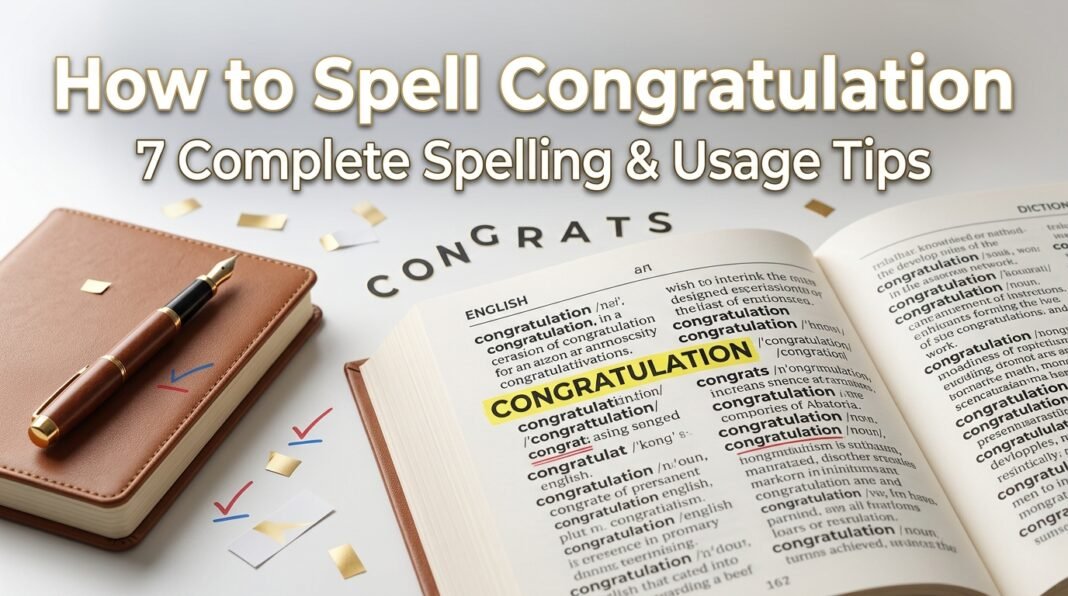
Knowing how to spell a word correctly is an important part of clear and confident communication. Some English words can be particularly confusing because their spelling looks different from the way they sound. The word “congratulation” is one of those words that people sometimes hesitate to write correctly. If you have searched for how to spell congratulation, you are likely looking for the correct spelling, meaning, pronunciation, and proper way to use the word in English.
The correct spelling is congratulation. The word contains several letters that can be easy to miss or rearrange, especially when writing quickly. It is also closely connected to the much more commonly used word congratulations, which can make the spelling and grammar slightly confusing for English learners. Understanding the difference between these related words can make your writing more accurate and natural.
The word “congratulation” refers to an expression of praise or good wishes given to someone because of an achievement, success, or happy event. In modern everyday English, however, the plural form “congratulations” is much more commonly used when directly expressing good wishes to someone. Learning this distinction is just as important as learning the spelling itself.
How to Spell Congratulation Correctly
If you are wondering how to spell congratulation, the correct spelling is congratulation. It begins with “congrat” and ends with “ulation.” The complete spelling contains fourteen letters: c-o-n-g-r-a-t-u-l-a-t-i-o-n.
The word can be divided mentally into smaller parts to make it easier to remember. The beginning is connected to “congratulate,” while the ending “-ion” turns the related verb into a noun. Understanding the structure of the word can make its spelling easier to remember instead of trying to memorize every letter separately.
One common reason people struggle with this word is that its pronunciation does not always make every letter obvious. When a word is pronounced naturally, some sounds can seem to blend. This may cause writers to leave out a letter, add an unnecessary letter, or place letters in the wrong order.
Correct spelling is especially important when writing professional messages, formal communications, greeting cards, social media posts, blog articles, and personal messages. A correctly spelled word makes your writing easier to understand and gives the reader confidence in the quality of your communication.
The spelling congratulation is correct when referring to the singular noun. The plural form is congratulations, which adds an “s” at the end. Although the two forms are closely related, they do not always function in exactly the same way in a sentence.
Understanding the Word Congratulation
The word “congratulation” is a noun related to the verb “congratulate.” It describes an expression of praise or good wishes directed toward someone after a positive achievement or event.
The concept behind the word is connected with recognizing another person’s success or happiness. When someone reaches an important goal, completes an achievement, receives an award, gets married, graduates, or experiences another positive milestone, congratulations can be offered as a way of showing appreciation and happiness for that person’s success.
Although the singular noun is grammatically valid, modern English usually favors the plural expression “congratulations” when people directly communicate good wishes. This is one reason learners may encounter “congratulations” much more frequently than “congratulation.”
The singular word still has an important place in English vocabulary. It can appear in formal writing, dictionary definitions, discussions about language, and grammatical constructions. Understanding this distinction helps prevent confusion when you encounter the word in different contexts.
Learning vocabulary is not only about memorizing spelling. It also involves understanding how a word functions, what it means, and how native speakers generally use it. With “congratulation,” spelling and usage are closely connected because the plural form is so much more common in everyday communication.
How to Spell Congratulations Correctly
The word congratulations is spelled c-o-n-g-r-a-t-u-l-a-t-i-o-n-s. It is the plural form associated with “congratulation.”
The extra “s” at the end changes the form of the word but does not change the main spelling structure. The central part remains “congratulation.” Once you know how to spell congratulation, adding “s” to create “congratulations” becomes straightforward.
Because “congratulations” is extremely common in everyday English, many people actually learn the plural form first. They may recognize the word visually without knowing how the singular form is spelled. This can make it difficult when they later encounter “congratulation” in a different grammatical context.
The spelling becomes easier when you recognize the relationship between the two forms. Rather than treating them as completely different words, think of “congratulations” as the plural form of “congratulation.”
Correctly spelling both forms is useful for anyone who regularly communicates in English. Whether you are writing personal messages, professional emails, articles, captions, announcements, or formal documents, understanding the spelling will help you communicate more confidently.
Congratulation vs. Congratulations
One of the most important things to understand after learning how to spell congratulation is the difference between “congratulation” and “congratulations.”“Congratulation” is the singular noun. “Congratulations” is the plural form and is also the conventional expression used when directly praising someone for an achievement or positive event.
In modern English, the plural form has become the standard expression for offering good wishes. This is why you will normally see “Congratulations” used in messages celebrating achievements, milestones, weddings, graduations, promotions, awards, and other positive events.
The singular form can still be grammatically correct, but its use is more limited. It often appears when discussing the concept of congratulating someone rather than functioning as the direct expression itself.
This distinction is important because English contains many words whose grammatical forms do not always correspond to their most common conversational use. “Congratulations” is a familiar expression that has become established through long-standing English usage.
For English learners, it is useful to remember that knowing the dictionary form of a word does not automatically mean that form will be the most natural choice in everyday communication. Vocabulary knowledge includes both spelling and practical usage.
Why Is Congratulations More Common?
The plural form “congratulations” has become the conventional way of expressing praise and good wishes. It is commonly used as a standalone expression and as part of longer sentences.
Language develops through repeated usage, and certain expressions become established over time. “Congratulations” is one of those expressions that has become deeply familiar in English-speaking communication.
When people want to acknowledge someone’s success, the plural form sounds natural and immediately communicates positive recognition. This is why it appears frequently in conversations, greeting cards, social media posts, speeches, workplace communication, and personal messages.
The popularity of “congratulations” does not make “congratulation” an incorrect word. Instead, it means that the plural form has a more established role in everyday communication. Understanding this difference can help English learners avoid assuming that the less common form is automatically wrong. A word can be grammatically correct while still being less common in ordinary conversation.
Common Spelling Problems With Congratulation
People may make several spelling mistakes when writing “congratulation.” These mistakes often happen because the word is relatively long and contains several consecutive letters that are easy to confuse.
The first part, “congrat,” should remain consistent. Writers sometimes accidentally change the order of letters or leave out one of the letters in this section. Paying attention to the word structure can reduce these errors.
The middle section can also confuse because the transition from “congrat” to “ulation” may sound less obvious when spoken quickly. Writing the word slowly can help you identify every letter. Another common issue is confusing the singular and plural forms. Someone may add or remove the final “s” without considering whether the sentence requires “congratulation” or “congratulations.”
Spelling mistakes are especially easy to make when typing quickly on a phone. Autocorrect can sometimes correct words automatically, but it should not be relied upon completely. Developing a visual memory of the correct spelling is a more dependable long-term strategy. Reading the word regularly can also help. The more frequently you see a correctly spelled word, the easier it becomes to recognize when something looks incorrect.
How to Remember the Spelling of Congratulation
One effective way to remember how to spell congratulation is to break the word into recognizable sections. Instead of attempting to memorize all fourteen letters at once, identify the major parts of the word.
The beginning “congrat” is especially important. Once this part becomes familiar, the remaining “ulation” section can be connected to it naturally.
Another useful approach is to connect “congratulation” with the verb “congratulate.” Both words share the same central spelling pattern. Recognizing related words can make vocabulary easier to remember because you are learning a group of connected forms rather than isolated words.
Writing the word several times can also reinforce visual memory. Repeated exposure helps the correct sequence of letters become familiar. Over time, you may begin to recognize the correct spelling automatically.
Pronunciation can also support spelling, but it should not be the only method. English spelling is not always perfectly predictable from pronunciation. Looking at the written word and understanding its structure provides stronger support.
Another helpful habit is to read high-quality English content regularly. Books, articles, professional websites, and reliable publications expose you to correctly spelled vocabulary in natural contexts. This gradually strengthens both spelling and grammar awareness.
The Relationship Between Congratulate and Congratulation
The word “congratulation” is closely related to the verb “congratulate.” Understanding this relationship makes the spelling easier to understand.“Congratulate” is the verb used when someone expresses praise or good wishes toward another person. “Congratulation” is the related noun that refers to the expression or act of congratulating.
The shared “congratulat” structure is important because it shows why the words look similar. Once you understand this connection, spelling becomes less dependent on memorization. English frequently creates nouns from verbs through changes in endings. Learning common word families can therefore improve spelling skills across many different vocabulary groups.
When you encounter unfamiliar vocabulary, looking for related words can provide clues about spelling and meaning. This strategy is useful not only for “congratulation” but also for many other English words.
Is Congratulation a Correct Word?
Yes, “congratulation” is a correctly spelled English word. It is the singular noun associated with the verb “congratulate.”However, being a correct word does not mean that it is equally common in every situation. Modern English speakers usually use “congratulations” when directly expressing good wishes.
This distinction is important for learners who may assume that a less frequently used word is incorrect simply because they rarely hear it. Vocabulary should be understood through both dictionary definitions and real-world usage.
A reliable dictionary can help confirm spelling, pronunciation, grammatical category, and meaning. Consulting dictionaries is a useful habit whenever you are uncertain about an unfamiliar word.
How to Use Congratulation in English
The word “congratulation” functions as a noun. Its meaning is connected to praise, recognition, or good wishes following an achievement or positive event. Its usage depends on the grammatical structure of the sentence. In everyday communication, the plural “congratulations” is generally more natural when directly addressing someone.
The singular form may appear in formal or descriptive contexts where the concept of congratulation is being discussed rather than delivered as a direct message. Understanding this distinction helps writers choose vocabulary based on context instead of simply choosing a word because it appears in a dictionary.
Good English writing requires more than correct spelling. Grammar, word choice, sentence structure, punctuation, and context all contribute to natural communication. Learning these aspects together can significantly improve writing confidence.
Why Spelling Matters in English Communication
Correct spelling plays an important role in written communication. A spelling error can make a message appear rushed or unclear, especially in professional situations. When writing about achievements, celebrations, and important events, correct spelling becomes particularly useful because these messages often carry emotional or social significance.
A correctly written message shows attention to detail. It also helps the reader understand the intended meaning without distraction.
For website owners and content writers, spelling is even more important. Search engines can understand many spelling variations, but readers expect professional content to use standard English. Consistent spelling contributes to overall content quality and readability.
For students, accurate spelling can affect written assignments, examinations, presentations, and communication with teachers. Developing strong spelling habits early can therefore provide benefits across many areas of life.
The Importance of Understanding Word Forms
English words often change form depending on their grammatical role. Understanding these forms can make spelling easier because you begin to see patterns rather than individual words.Congratulate,” “congratulation,” and “congratulations” are related forms. Learning them together provides a clearer picture of how English vocabulary works.
Word families are especially useful for language learners because one familiar word can help you understand several related words. This can increase vocabulary more efficiently than memorizing unrelated terms. The spelling of a related word can also provide clues when you encounter another form. Recognizing shared roots and endings makes writing more predictable.
For this reason, learning how to spell congratulation should not be treated as an isolated spelling exercise. It can become part of a broader understanding of English vocabulary and word formation.
How Pronunciation Can Affect Spelling
Pronunciation and spelling are connected, but they are not identical. English contains many words whose written forms cannot be predicted perfectly from their pronunciation.“Congratulation” contains several syllables, and some of its sounds may blend during normal speech. This can make it difficult for learners to identify every letter simply by listening.
Writing the word slowly can help separate its sounds and spelling patterns. Reading it aloud while looking at the written form can also create a stronger connection between pronunciation and spelling.
However, visual memory remains important. Seeing the correct word repeatedly helps establish a mental image of the proper letter sequence. Combining reading, writing, pronunciation, and contextual understanding is generally more effective than relying on a single method.
How to Improve Your English Spelling Skills
Improving spelling requires consistent exposure and practice. One of the simplest methods is to read English regularly. Reading introduces you to correctly spelled words in natural contexts and allows your brain to recognize common patterns.
Writing regularly is equally important. When you actively produce words, you become more aware of spelling decisions that passive reading may not highlight. Using a dictionary is another useful habit. Modern online dictionaries can provide spelling, pronunciation, definitions, grammatical information, and related words in one place.
Spell-checking tools can support your writing, but they should be considered assistance rather than a replacement for learning. Automatic correction can occasionally introduce unwanted changes, especially when a word has multiple possible forms.
Keeping a personal list of difficult words can also help. Whenever you repeatedly make a spelling mistake, recording the correct spelling gives you a reference point for future writing. Over time, repeated exposure and practice can turn difficult spellings into familiar ones.
How to Spell Congratulation in Professional Writing
Professional communication requires accuracy, clarity, and appropriate word choice. If you are writing an email, announcement, business message, article, or formal document, spelling “congratulation” correctly is important.
In professional settings, the plural “congratulations” will often be the more natural form when directly recognizing someone’s success. The choice should depend on the grammatical structure and purpose of the sentence. Professional writing should avoid unnecessary spelling variations. Consistency helps maintain credibility and makes the content easier to read.
Proofreading before sending or publishing content can catch spelling errors that are easy to overlook during drafting. Reading the text slowly can reveal mistakes that remain invisible during quick editing. A professional writing process usually includes drafting, reviewing, correcting, and final proofreading. This approach helps ensure that important words such as “congratulation” are written correctly.
How to Spell Congratulation in Digital Communication
Digital communication has made spelling both easier and more challenging. Spell-checkers, predictive text, and autocorrect features can correct many mistakes automatically, but they can also create confusion.
People often type quickly on smartphones and social media platforms. This can result in missing letters, repeated letters, or incorrect word forms. When writing important messages, it is useful to pause and review the text before sending it. A few seconds of proofreading can prevent unnecessary spelling errors.
The same principle applies to website content. Blog posts, social media captions, newsletters, and online profiles represent the writer or organization. Correct spelling contributes to a professional appearance. Even when communication is informal, learning the correct spelling remains valuable because it strengthens overall language skills.
For a reliable reference on the meaning, spelling, pronunciation, and grammatical information related to congratulation and congratulations, readers can consult Merriam-Webster Dictionary. A trusted dictionary can help readers understand how a word is defined, pronounced, and used in standard English.
FAQ
How do you spell congratulation?
The correct spelling is congratulation. The letters are c-o-n-g-r-a-t-u-l-a-t-i-o-n. It is the singular noun related to the verb “congratulate.”
Is congratulation or congratulations correct?
Both are correctly spelled words, but they have different grammatical forms and uses. “Congratulation” is singular, while “congratulations” is plural. The plural form is much more commonly used as a direct expression of good wishes.
How do you spell congratulations?
The correct spelling is congratulations. It is spelled c-o-n-g-r-a-t-u-l-a-t-i-o-n-s. The final “s” distinguishes it from the singular form.
What is the difference between congratulation and congratulations?
“Congratulation” is the singular noun, while “congratulations” is the plural form. In modern everyday English, “congratulations” is the conventional expression used to praise someone for an achievement or positive event.
Is congratulation grammatically correct?
Yes. “Congratulation” is a valid English noun. However, its grammatical use is different from the common expression “congratulations,” which is generally preferred when directly offering good wishes.
Why do we say congratulations instead of congratulation?
The plural form “congratulations” has become the conventional expression in English for communicating praise and good wishes. It is widely established in everyday speech and writing.
What is the correct spelling of congratulation?
The correct spelling is congratulation. Remember the structure “congrat” followed by “ulation” and ending with “ion.”
Is congratulations singular or plural?
“Congratulations” is grammatically plural in form. However, it is commonly used as a fixed expression when communicating praise or good wishes to another person.
Does congratulation have an S?
The singular form “congratulation” does not have an “s” at the end. The plural form “congratulations” adds “s” to the end.
What verb is related to congratulation?
The related verb is congratulate. Both words share the central “congratulat” spelling pattern and are connected in meaning.
Final Thoughts
If you have been searching for how to spell congratulation, the key answer is simple: the correct spelling is congratulation. The word contains fourteen letters and is the singular noun related to the verb “congratulate.”
The plural form congratulations is much more common in everyday English, especially when directly expressing praise or good wishes. Understanding the difference between these two forms will help you choose the right word for the context.
Remembering the spelling becomes easier when you recognize the structure of the word and its connection to related vocabulary. Reading the word regularly, writing it correctly, and paying attention to its grammatical form can gradually make the spelling automatic.
Correct spelling is a small but important part of effective communication. Whether you are writing a personal message, professional communication, website article, social media post, or formal document, using the correct word form helps your writing remain clear and polished.
The most important spelling to remember is congratulation, while the familiar expression used in everyday communication is congratulations. Once you understand both forms and their relationship, there is much less reason to hesitate when writing either word.