

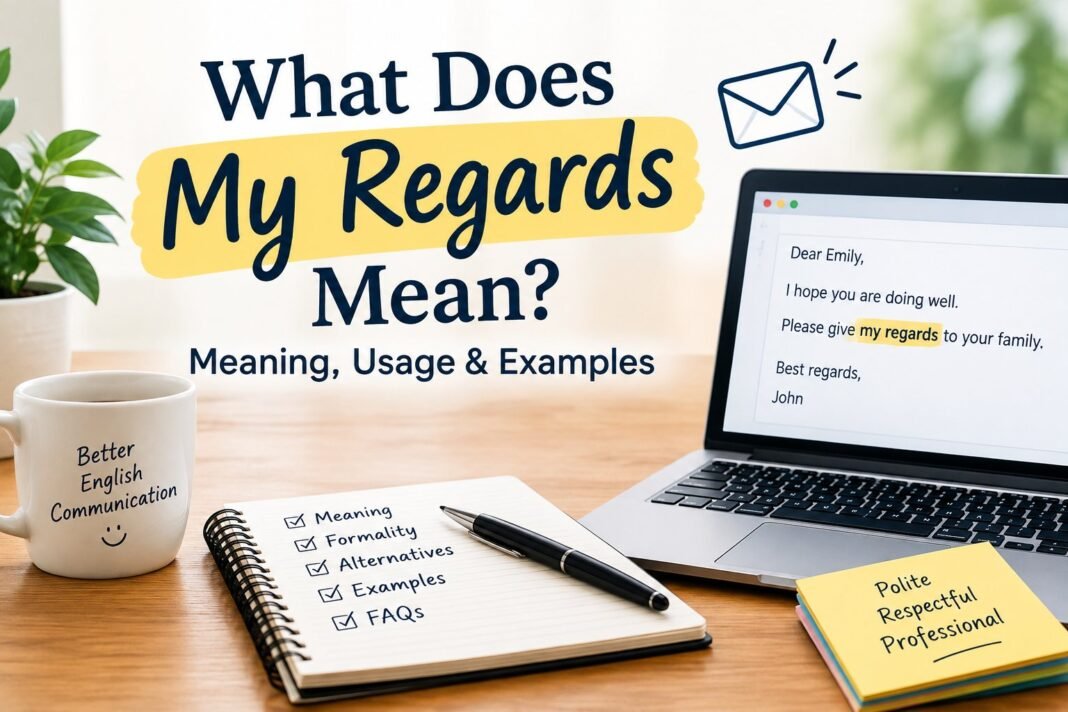
Have you ever read a message or email that included the phrase “my regards” and wondered what the person really meant? This is a common question for English learners because the word “regards” can have slightly different meanings depending on how it is used.
The phrase “my regards” is generally a polite way to express greetings, respect, goodwill, or good wishes toward someone. It is often used in conversations, letters, emails, and professional communication. Although the phrase may sound formal, its meaning is usually simple and positive.
Understanding what does my regards mean can help you communicate more naturally in English. It can also help you understand the tone of emails and messages you receive from other people. The phrase is not usually difficult to understand once you know how the word “regards” works in different situations.
In this article, we will look closely at the meaning of “my regards,” how the phrase is used, when it sounds appropriate, and how it differs from expressions such as “best regards,” “kind regards,” and “warm regards.” We will also discuss common mistakes and answer some frequently asked questions about the expression.
What Does My Regards Mean?
The phrase “my regards” means my greetings, good wishes, or expressions of respect. When someone sends their regards, they are communicating a positive feeling toward another person.
The exact meaning depends on the situation. In a personal conversation, “my regards” can mean that someone wants to send greetings to another person. In a professional setting, it can communicate politeness and respect.
The word “my” shows that the greetings or good wishes belong to the person speaking or writing. The word “regards” refers to feelings of respect, goodwill, or friendly consideration.
Therefore, when someone says “my regards,” they are usually expressing a polite and positive message. The phrase does not normally carry a negative meaning.
It can sometimes be understood as “my greetings” or “my best wishes.” In certain situations, it can also be understood as a polite way of saying that someone should be remembered or greeted.
The Simple Meaning of Regards
The word “regards” has several meanings in English, but in expressions such as “my regards,” it usually refers to greetings, respect, or good wishes.
The meaning becomes clearer when you consider the relationship between the people involved. If a person asks someone to give their regards to a family member, they are asking that person to pass along their greetings.
In professional communication, “regards” often has a slightly different function. It is commonly used as part of an email closing. In that situation, it helps create a polite and respectful ending.
This is why “regards” appears frequently in business emails. It allows the writer to finish a message in a professional way without sounding extremely formal.
The word is flexible because it can work in both personal and professional communication. The tone depends on the surrounding words and the relationship between the people.
What Does My Regards Mean in a Conversation?
When someone uses “my regards” in a conversation, they are generally sending greetings or good wishes to another person.
This often happens when two people are talking about someone who is not present. One person may want to communicate a message to that absent person through the person they are speaking with.
The expression can also show respect. If someone asks you to give their regards to your parents, family, teacher, or colleague, they are showing that they have positive feelings toward that person.
The phrase is particularly useful when the speaker wants to sound polite. It is more formal than simply saying “say hi” or “tell them I said hello.”
However, it does not necessarily mean that the speaker has a very close relationship with the person receiving the regards. It can simply be a courteous expression.
What Does Give My Regards Mean?
“Give my regards” means to pass along my greetings or good wishes to someone.
This expression is normally used when the person sending the regards is not speaking directly to the person they are greeting. Instead, another person acts as the connection between them.
The phrase can be used with family members, friends, colleagues, teachers, business partners, and other people.
It is polite and respectful. It can also sound warm when used in a personal situation.
The expression “give my regards” is usually easy for native English speakers to understand. It is a traditional phrase that has been used for many years in both spoken and written English.
What Does Send My Regards Mean?
“Send my regards” has a meaning very similar to “give my regards.” It means that you want your greetings or good wishes to reach another person.
The difference is very small. “Give my regards” often sounds more conversational, while “send my regards” can work naturally in both spoken and written communication.
Both phrases communicate goodwill.
The important idea is that the speaker wants another person to receive their greetings. It does not necessarily mean that a physical message or letter must be sent.
What Does Convey My Regards Mean?
“Convey my regards” is a more formal expression. The word “convey” means to communicate or pass something from one person to another.
Therefore, “convey my regards” means to communicate your greetings or good wishes to someone.
This phrase is more likely to appear in formal letters, professional communication, or situations where respectful language is expected.
Compared with “give my regards,” the expression “convey my regards” sounds more formal and traditional.
The basic meaning remains the same. Both expressions communicate greetings and goodwill.
Is My Regards Formal?
“My regards” can sound formal or semi-formal, depending on how it is used.
It is more formal than casual expressions such as “say hi” or “tell them I said hello.” However, it is not so formal that it can only be used in official documents.
The phrase is often appropriate when speaking to someone you respect or when communicating in a professional environment.
It can also be used between people who know each other well. In that situation, the phrase may sound polite and slightly traditional.
The level of formality is strongly influenced by the complete sentence. The same phrase can sound different depending on whether it appears in a business email or a personal conversation.
What Does My Regards Mean in an Email?
In email communication, “regards” is often used as part of a closing phrase.
Professional emails frequently end with expressions such as “Best regards,” “Kind regards,” or simply “Regards.”
These phrases provide a polite ending to the message. They communicate professionalism while maintaining a respectful tone.
“My regards” itself is less common as a standalone email closing than “Best regards” or “Kind regards.” However, it can still appear in formal writing when the writer wants to communicate respect or goodwill.
Understanding this difference is important for English learners. “My regards” often refers to greetings being sent to someone, while “best regards” is commonly used as a sign-off.
Best Regards and My Regards
“Best regards” and “my regards” are closely related, but they are not always used in the same way.
“Best regards” is one of the most common professional email closings. It is used at the end of an email to express politeness and goodwill toward the recipient.
“My regards” is more often connected with sending greetings or good wishes to another person.
The word “regards” is present in both expressions, but their grammatical function can be different.
This is why replacing one phrase with the other does not always produce the same meaning.
If you are writing a professional email, “Best regards” is generally a natural and safe choice. If you are asking someone to pass your greetings to another person, “my regards” is more suitable.
My Regards and Kind Regards
“Kind regards” is another popular expression in professional communication.
It is commonly used at the end of emails and letters. The phrase sounds polite, professional, and slightly warm.
“My regards” and “kind regards” both communicate positive feelings, but their usual uses differ.
“My regards” can refer to greetings that are being passed to another person. “Kind regards” usually functions as a professional sign-off.
Both expressions are respectful.
The choice depends on the situation and the tone you want to create.
My Regards and Warm Regards
“Warm regards” has a friendlier and more personal tone.
The word “warm” adds a feeling of friendliness and personal goodwill. Because of this, “warm regards” can be useful when communicating with someone you already know or when the situation is more personal.
“My regards” is more neutral.
It can communicate respect without necessarily showing strong emotion.
This difference is useful when choosing an email closing. A business relationship may call for “Best regards,” while a friendly professional relationship may allow “Warm regards.”
My Regards and Best Wishes
“My regards” and “best wishes” are both positive expressions, but they are not exactly the same.
“My regards” is generally connected with greetings, respect, and goodwill.
“Best wishes” often communicates hopes for someone’s happiness, success, health, or future.
The two phrases can sometimes appear together because they complement each other.
“My regards” is more focused on respectful greetings. “Best wishes” is more focused on positive hopes.
Understanding this small difference can make your English sound more natural.
How to Use My Regards Correctly
Using “my regards” correctly depends on the situation.
When you are sending greetings through another person, the phrase is completely natural. It can be used when talking about family members, friends, colleagues, or other people.
The expression is also useful in formal communication when you want to communicate respect.
However, you should avoid using overly formal expressions in very casual conversations if they do not match your normal speaking style.
English communication is not only about grammar. It is also about tone.
Choosing words that match the relationship and situation is an important part of effective communication.
My Regards in Professional Communication
Professional communication requires a balance between politeness and clarity.
The expression “regards” works well because it sounds professional without being excessively formal.
Business emails often need a courteous ending. A simple closing can make the entire message feel more complete.
“Best regards” and “Kind regards” are particularly common because they are professional and widely accepted.
If you are communicating with a client, manager, colleague, customer, or business partner, these expressions can help maintain a respectful tone.
“My regards” can also be appropriate when you are passing greetings to another person within a professional context.
My Regards in Personal Communication
Although “my regards” can sound formal, it is not limited to professional communication.
People can use the phrase when sending greetings to family members, friends, or acquaintances.
The expression may sound slightly more traditional than casual alternatives, but it is still understandable and polite.
For close friends, everyday English often uses simpler expressions. However, “my regards” can be useful when you want to sound especially polite or respectful.
The key is to match the expression with the relationship.
Can You Say My Regards to a Friend?
Yes, you can use “my regards” when talking about a friend.
However, the phrase may sound more formal than the language you normally use with a close friend.
English has many ways to communicate greetings. Casual expressions tend to sound more natural among close friends, while “my regards” can create a more polite or traditional tone.
There is nothing grammatically wrong with using it with a friend.
The choice is mainly about style and context.
Can You Say My Regards to a Family Member?
Yes.
“My regards” can be used when sending greetings to a family member who is not present.
It can communicate affection, respect, or goodwill depending on the context.
The phrase is particularly common when one person is asking another person to pass along greetings.
It can also be used in situations where family members live in different places and communicate through other relatives or friends.
Can You Use My Regards With a Teacher?
Yes.
The phrase can be appropriate when communicating respectfully with or about a teacher.
Teachers, professors, and academic professionals often receive formal or semi-formal communication. In these situations, respectful language is usually appropriate.
When ending a direct email to a teacher, “Kind regards” or “Best regards” may sound more natural.
When asking someone to pass greetings to a teacher, “my regards” can work well.
Can You Use My Regards With a Client?
Yes.
Professional relationships often require respectful communication, and “regards” is widely accepted in business English.
When communicating directly with a client through email, “Best regards” or “Kind regards” is usually a natural closing.
When communicating through another person, “my regards” can be used to send greetings to the client.
The important thing is to maintain a professional tone throughout the entire message.
Is My Regards Polite?
Yes, “my regards” is generally polite.
The phrase communicates respect, goodwill, or greetings. It is not normally considered rude or offensive.
However, tone depends on context.
A phrase can be grammatically correct while still sounding unusual if it does not match the situation.
“My regards” usually sounds polite because it carries a respectful meaning.
Is Regards Rude in an Email?
No, “Regards” is not inherently rude.
It is a standard professional email closing.
However, some people may find a simple “Regards” slightly colder or more distant than “Best regards” or “Kind regards.”
This does not mean it is impolite.
It simply has a shorter and more neutral tone.
If you want your email to sound warmer, adding “Best” or “Kind” before “regards” can make the closing feel friendlier.
Why Do People Use Regards in Emails?
People use “regards” because it provides a simple and professional way to close an email.
Without a closing, an email can sometimes feel abrupt. A sign-off creates a clear ending and communicates courtesy.
“Regards” is popular because it is neutral.
It does not create a strong emotional tone. It can work in many professional situations.
This flexibility makes it useful for workplace communication.
Common Alternatives to My Regards
There are many alternatives to “my regards,” and each one has a slightly different tone.
“Best regards” is a common professional closing.
“Kind regards” is polite and professional with a slightly warmer feeling.
“Warm regards” sounds more personal and friendly.
“Best wishes” communicates positive hopes and goodwill.
“All the best” is more relaxed and conversational.
“Sincerely” is commonly used in formal letters.
“Respectfully” has a more formal and serious tone.
The best choice depends on the relationship, purpose, and level of formality.
When Should You Use Best Regards?
“Best regards” is especially useful when writing professional emails.
It works well when communicating with colleagues, clients, customers, managers, teachers, and business contacts.
The phrase is neither too casual nor excessively formal.
It can be used for many everyday professional situations.
Because of its flexibility, “Best regards” is one of the safest email closings for workplace communication.
When Should You Use Kind Regards?
“Kind regards” is useful when you want to sound professional and polite while maintaining a friendly tone.
It is common in business emails and other professional communication.
Some people prefer it when they want their message to sound slightly warmer than a simple “Regards.”
It is also appropriate when communicating with someone for the first time.
When Should You Use Warm Regards?
“Warm regards” is best when you want to communicate a stronger feeling of friendliness.
It can work well with people you already know.
The expression can also be appropriate in messages related to congratulations, appreciation, personal achievements, or other positive situations.
Because “warm” adds emotion, it may not be suitable for every formal business situation.
Common Mistakes With My Regards
One common mistake is assuming that “my regards” always means exactly the same thing as “best regards.”
Although the expressions are related, they are commonly used in different contexts.
Another mistake is using highly formal language in casual conversations.
The phrase can sound unnatural if the surrounding language is extremely informal.
Another issue is punctuation. Email closings are normally separated from the main message and followed by the sender’s name.
Understanding the function of the phrase is more important than simply memorizing it.
Is My Regards the Same as Hello?
Not exactly.
“My regards” can communicate greetings, but it also carries a sense of respect and goodwill.
“Hello” is a direct greeting.
When someone asks you to give their regards to another person, they are essentially asking you to communicate their greetings and good wishes.
The meaning is therefore related to saying hello, but the tone is different.
“My regards” is more formal and respectful.
Is My Regards the Same as Best Wishes?
Not exactly.
Both expressions communicate positive feelings, but their focus differs.
“My regards” is usually about greetings and respect.
“Best wishes” is usually about hoping for something positive for another person.
They can sometimes be used together because their meanings complement each other.
How Do You Respond When Someone Sends Their Regards?
A simple and polite response is usually enough.
You can acknowledge the message and let the person know that you will pass along their greetings.
There is no complicated response required.
The appropriate response depends on the relationship and situation.
In casual communication, a short acknowledgment is perfectly natural. In formal communication, a slightly more polite response may be appropriate.
Why Is Understanding My Regards Important?
Understanding phrases like “my regards” is useful for anyone learning English.
Small expressions can carry information about tone, politeness, and relationships.
Knowing the difference between casual and formal expressions can make your communication more effective.
It can also help you understand professional emails more easily.
Instead of translating every word separately, understanding the phrase as a complete expression makes communication much easier.
My Regards in Modern English
Although “my regards” has a traditional sound, the word “regards” is still common in modern English.
Professional emails frequently use “Best regards,” “Kind regards,” and “Regards.”
The expression remains relevant because it is simple and flexible.
Modern communication may be more casual than older forms of letter writing, but polite expressions are still important.
The exact choice of wording depends on the platform and relationship.
My Regards in Business Emails
Business communication often requires careful attention to tone.
A message should be clear, respectful, and professional.
Using an appropriate closing can help create a positive impression.
“Best regards” is particularly common because it sounds professional without being overly formal.
“Kind regards” can create a slightly warmer impression.
“Regards” can be used when a more neutral and concise tone is preferred.
“My regards” is more useful when communicating greetings through another person.
My Regards in Letters
Letters often use more formal language than casual messages.
The expression “my regards” can therefore feel natural in formal written communication.
It may be used to communicate respect or goodwill.
Traditional letter writing also uses expressions such as “with regards,” “best wishes,” and “sincerely.”
The choice depends on the purpose of the letter and the relationship between the sender and recipient.
What Does My Regards Mean in British English?
“My regards” and related expressions are well understood in British English.
“Kind regards” is particularly common in professional British communication.
“Best regards” is also widely understood and used.
The fundamental meaning remains the same.
The phrase communicates greetings, respect, or goodwill.
What Does My Regards Mean in American English?
The phrase is also understood in American English.
American professional communication commonly uses “Best regards,” “Regards,” and other email closings.
The meaning of “my regards” remains essentially the same.
Regional differences may affect how often certain expressions are used, but the basic meaning does not change significantly.
For learners who want to understand English expressions in greater detail, the Merriam-Webster Dictionary is another useful resource. It provides definitions, examples of usage, and information about how words function in everyday English. Reviewing the meaning and usage of “regards” through a trusted dictionary can make it easier to choose the right expression when writing emails, letters, or personal messages.
How to Choose the Right Expression
Choosing between “my regards,” “best regards,” “kind regards,” and “warm regards” is mainly about context.
Think about your relationship with the recipient.
Consider whether the communication is professional or personal.
Think about whether you are directly addressing the person or sending greetings through someone else.
Also consider how formal you want to sound.
For direct professional emails, “Best regards” and “Kind regards” are usually strong choices.
For passing greetings to another person, “my regards” is more appropriate.
For a friendly professional relationship, “Warm regards” can work well.
FAQ
What does my regards mean?
“My regards” means my greetings, good wishes, or expressions of respect. It is a polite phrase commonly used in personal and professional communication.
Is my regards formal?
Yes, “my regards” can sound formal or semi-formal. It is more formal than casual expressions such as “say hi.”
What does give my regards mean?
“Give my regards” means to pass along your greetings or good wishes to another person.
What does send my regards mean?
“Send my regards” means to communicate your greetings or good wishes to someone who is not directly present.
What does convey my regards mean?
“Convey my regards” means to communicate or pass your greetings and good wishes to another person. It has a more formal tone.
Can I use my regards in an email?
Yes, but “Best regards” or “Kind regards” is generally more natural as a professional email closing.
Is regards rude?
No. “Regards” is a polite and professional expression. However, a simple “Regards” can sometimes sound more neutral or distant than “Best regards.”
Is best regards the same as my regards?
They are related but commonly used differently. “Best regards” is usually an email or letter closing, while “my regards” often refers to sending greetings to another person.
Can I say my regards to a friend?
Yes. It is grammatically correct, although it may sound more formal than casual expressions commonly used between close friends.
Can I use my regards with a client?
Yes. “Regards” is common in professional communication. “Best regards” and “Kind regards” are particularly suitable for professional emails.
What is another way to say my regards?
Depending on the context, alternatives include “my greetings,” “my best wishes,” “send my greetings,” “give them my best,” and “say hello for me.”
Is kind regards better than best regards?
Neither is universally better. Both are professional. “Kind regards” can sound slightly warmer, while “Best regards” is extremely common and versatile.
Is warm regards professional?
Yes, but it has a more personal and friendly tone. It can be appropriate when you already have a positive relationship with the recipient.
Does my regards mean respect?
It can. In many contexts, “my regards” communicates respect, goodwill, or polite greetings.
Can my regards be used in formal letters?
Yes. The phrase can be used in formal or semi-formal written communication, depending on the context.
Final Thoughts
So, what does my regards mean? In simple terms, “my regards” means greetings, good wishes, or expressions of respect. It is a polite phrase that can be used in both personal and professional communication.
The meaning becomes especially clear when you look at how the phrase is used. When someone asks another person to give their regards, they are asking that person to pass along their greetings or good wishes.
In professional emails, “regards” often appears in closing phrases such as “Best regards” and “Kind regards.” These expressions provide a polite ending to a message and help maintain a professional tone.
“My regards” is slightly different because it is commonly associated with sending greetings to another person. It can sound formal, respectful, and sometimes traditional.
Knowing the difference between these expressions can make your English communication more natural. It can also help you understand the tone of messages you receive.
The most important thing is to choose your words according to the situation. Casual conversations may call for simple language, while professional communication may benefit from expressions such as “Best regards” or “Kind regards.”
Once you understand the meaning of “my regards,” the phrase becomes much easier to recognize and use correctly. It is a simple expression, but it can communicate respect, goodwill, and friendly greetings in a clear and polite way.