

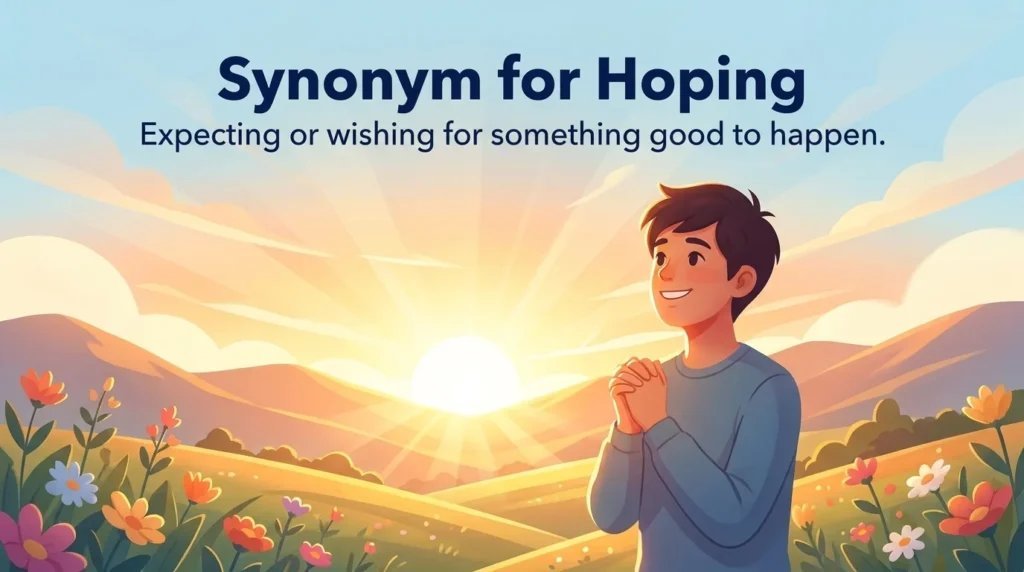
Finding the right word can make a big difference in how clearly we express our thoughts. The word “hoping” is common in everyday English, but sometimes another word may fit the situation better.
If you are wondering what is another word for hoping, there are many possible alternatives. The right choice depends on the meaning, tone, and situation.
Some alternatives sound more formal. Others are emotional, casual, positive, or strongly connected with expectations. Words such as wishing, expecting, anticipating, trusting, believing, longing, and looking forward to can all be related to the idea of hoping.
However, these words are not always exact replacements. Each one carries a slightly different feeling.
Understanding these differences can help you choose better vocabulary for conversations, emails, articles, messages, and everyday communication.
What Is Another Word for Hoping?
The most common alternatives to hoping include wishing, expecting, anticipating, trusting, believing, desiring, longing, aspiring, and looking forward to.
The word you choose depends on what you want to communicate.
“Hoping” usually describes a positive desire for something to happen. It often suggests that the desired result is possible, but not completely certain.
This makes “hoping” different from words that express stronger certainty.
For instance, expecting something usually suggests a higher level of confidence. Wishing can express a strong desire without suggesting that the desired result is likely.
Anticipating often suggests that someone believes something is likely to happen. Looking forward to usually communicates positive feelings about something expected in the future.
Because of these differences, finding what is another word for hoping is not simply about finding one replacement word.
It is about understanding the exact feeling behind the word.
Why Do People Look for Another Word for Hoping?
People often search for alternative vocabulary because repeating the same word can make writing feel dull.
Using different words can make an article, message, essay, or conversation more natural.
In some situations, “hoping” may also sound too casual. A more formal alternative may be better for professional communication.
In other situations, a person may want a word that sounds more emotional or positive.
Vocabulary choices also depend on the strength of the feeling.
Sometimes a person simply wants something to happen. Sometimes they strongly believe it will happen. Sometimes they dream about a particular outcome even when there is little certainty.
The word “hoping” can cover many of these situations, but more specific vocabulary can communicate the intended meaning more accurately.
That is why understanding alternatives is useful.
25+ Words Related to Hoping
There are many words and phrases connected with the meaning of hoping.
The following alternatives can help you express similar ideas while adding different shades of meaning.
1. Wishing
“Wishing” is one of the closest alternatives to hoping.
It expresses a desire for something to happen or become true.
However, wishing can sometimes sound less realistic than hoping.
It may describe a personal desire without suggesting that the desired result is likely.
The word is common in everyday English and can be used in both casual and emotional communication.
2. Expecting
“Expecting” is related to hoping, but it usually suggests greater confidence.
When someone expects something, they generally believe that it is likely to happen.
This makes the word stronger than hoping in many situations.
Expecting can also be neutral. It does not always communicate the same emotional warmth associated with hope.
3. Anticipating
“Anticipating” is another useful alternative.
It describes looking ahead to something that is expected or considered likely.
The word often sounds more formal than hoping.
It is especially useful when discussing future events, plans, developments, or outcomes.
Anticipation can also involve excitement, depending on the context.
4. Trusting
“Trusting” can express hope when the feeling is connected to confidence in someone or something.
It suggests that a person believes a positive outcome will happen because they have faith or confidence.
This word is more emotionally focused than some other alternatives.
It can communicate reassurance, confidence, and faith.
5. Believing
“Believing” can sometimes replace hoping when the person has a strong sense of confidence.
Hope is usually connected to possibility.
Belief can suggest stronger personal confidence.
The two words can overlap, especially when someone wants a positive result and feels that the result is possible.
Still, belief generally carries more certainty than hope.
6. Desiring
“Desiring” expresses a strong wish or want.
It is more formal than hoping and is often used in professional, academic, or literary writing.
Desire focuses on what a person wants.
Hope focuses more on the possibility of that desire becoming reality.
This difference makes “desiring” useful when the emotional focus is on the wish itself.
7. Wanting
“Wanting” is a simple and natural alternative in some contexts.
It is one of the most common ways to express personal desire.
However, wanting does not necessarily include the sense of future possibility that is often present in hoping.
Someone can want something without believing it will happen.
For that reason, the two words are related but not identical.
8. Dreaming
“Dreaming” can express a strong emotional desire for a future possibility.
It often carries an imaginative or ambitious feeling.
Dreaming about something can suggest that a person thinks deeply about a desired future.
The word can sound more emotional and inspirational than hoping.
It is especially connected with ambitions, goals, and personal aspirations.
9. Looking Forward To
“Looking forward to” is a positive expression related to anticipation.
It usually suggests that someone expects a future event and feels positive about it.
This phrase is very common in everyday and professional communication.
It can communicate excitement, happiness, and positive anticipation.
The phrase is not always an exact replacement for hoping, but it can express a similar future-focused feeling.
10. Awaiting
“Awaiting” means waiting for something to happen or arrive.
It can be connected to hope when the person is positively expecting an outcome.
The word has a more formal tone.
It is often associated with situations where something is expected in the future.
Awaiting does not always include emotional hope, so context is important.
11. Aspiring
“Aspiring” is strongly connected with goals and ambitions.
It describes having a desire to achieve something in the future.
Unlike ordinary hoping, aspiring often involves personal effort and long-term goals.
The word is useful when discussing professional ambitions, personal development, education, or achievement.
12. Praying
“Praying” can express a very strong form of hope.
It is often connected with faith, spirituality, or a deeply emotional desire.
The word can suggest that someone wants a particular outcome very strongly.
It carries a more emotional meaning than ordinary hoping.
13. Longing
“Longing” describes a deep and often emotional desire.
It is stronger than ordinary wanting.
Longing can involve something a person deeply wishes to have, experience, achieve, or regain.
The word can sound emotional, serious, or even nostalgic.
14. Yearning
“Yearning” is another strong word for deep desire.
It suggests an intense emotional wish.
Compared with hoping, yearning usually communicates stronger feelings.
It is often used when someone wants something deeply and continuously.
15. Optimism
“Optimism” is not a direct synonym for hoping, but the concepts are closely related.
Optimism describes a positive attitude toward the future.
A person who is optimistic tends to believe that good things are possible.
Hope can be part of an optimistic outlook.
16. Counting On
“Counting on” suggests confidence that something or someone will meet an expectation.
It is stronger than simply hoping.
The phrase communicates trust and reliance.
It is useful when the person believes that a particular outcome is dependable.
17. Relying On
“Relying on” focuses on dependence and trust.
It can be related to hope when someone expects support or a particular result.
However, reliance is generally stronger than hope.
It suggests that a person depends on something happening.
18. Envisioning
“Envisioning” means imagining something as a possible future reality.
It can be connected with hope, ambition, and planning.
The word often appears in professional, creative, and personal-development contexts.
It focuses more on imagining a future than simply wishing for one.
19. Imagining
“Imagining” involves creating a picture of something in the mind.
It can be connected with hope when a person imagines a positive future.
However, imagining does not necessarily mean that the person wants the imagined situation to happen.
Therefore, it is related to hoping but not identical.
20. Seeking
“Seeking” means actively trying to find, achieve, or obtain something.
It is more action-oriented than hoping.
Hope can exist without action, while seeking usually suggests effort.
This makes the word useful when someone is actively working toward a desired outcome.
21. Holding Out Hope
“Holding out hope” is a phrase that expresses continued hope.
It often suggests that a person remains positive even when the situation is uncertain.
The phrase can communicate persistence and emotional strength.
It is stronger in emotional tone than the simple word “hoping.”
22. Keeping Faith
“Keeping faith” means continuing to believe or trust despite uncertainty.
It can express hope when someone remains confident in a positive outcome.
The phrase can have spiritual, emotional, or personal meaning.
It is particularly useful when the situation requires patience and confidence.
23. Staying Optimistic
“Staying optimistic” communicates a continued positive attitude.
It suggests that a person is choosing to focus on positive possibilities.
This expression is closely related to hope.
However, optimism describes an overall attitude rather than one specific desire.
24. Looking for a Positive Outcome
This phrase communicates the desire for a favorable result.
It is more descriptive than a single synonym.
The expression can sound neutral and professional.
It focuses directly on the desired result rather than the emotional experience of hoping.
25. Expecting the Best
“Expecting the best” expresses a positive outlook about the future.
It combines anticipation with optimism.
The phrase suggests that a person wants to remain positive about what may happen.
It can be used when the final result is not completely certain.
26. Keeping Hope Alive
“Keeping hope alive” expresses continued optimism during uncertainty.
It suggests that hope remains even when the situation is difficult.
The phrase has a strong emotional quality.
It focuses on maintaining a positive belief rather than simply having hope at one moment.
What Does Hoping Mean?
Hoping means having a positive desire or expectation about something that may happen in the future.
It usually involves uncertainty.
When people hope for something, they want the result to happen, but they may not know whether it will actually happen.
Hope is therefore connected with possibility.
It can be a simple feeling or a powerful emotional experience.
Hope can relate to personal goals, relationships, health, work, education, family, success, and many other areas of life.
The word is positive because it focuses on a desired outcome.
At the same time, it does not guarantee that the desired outcome will happen.
This balance between desire and uncertainty is one of the most important characteristics of hope.
What Is Another Word for Hoping in Different Situations?
The best alternative depends heavily on context.
A word that works well in casual conversation may not be appropriate in formal writing.
Likewise, an emotional word may not fit a professional situation.
Understanding the tone of each alternative makes vocabulary selection easier.
Formal Alternatives
For formal communication, words such as anticipating, expecting, awaiting, aspiring, and trusting can be useful.
These words often sound more polished.
They can work well in professional communication, academic writing, business content, and formal discussions.
The exact choice should depend on the intended meaning.
Casual Alternatives
Casual communication often works better with simple vocabulary.
Wishing, wanting, looking forward to, and hoping are natural choices.
These expressions are easy to understand.
They also sound comfortable in everyday conversations.
Emotional Alternatives
When the goal is to express strong feelings, words such as longing, yearning, dreaming, praying, and holding out hope can be more effective.
These words communicate more emotion.
They can make writing feel personal and meaningful.
Positive Alternatives
When the focus is positivity, optimism-related expressions are useful.
Believing, staying optimistic, expecting the best, keeping faith, and looking forward to all communicate positive feelings about the future.
They can create a hopeful and encouraging tone.
What Is Another Word for Hoping in Professional Writing?
Professional writing requires careful vocabulary choices.
“Hoping” is not necessarily too informal, but some contexts may benefit from more precise language.
Anticipating can sound professional when discussing expected developments.
Expecting can communicate confidence about a future result.
Aspiring is useful when discussing goals and ambitions.
Trusting can work when the meaning involves confidence or faith.
Awaiting can be appropriate when someone is waiting for a response, decision, event, or outcome.
The key is not to replace hoping automatically.
Instead, choose a word that accurately communicates the intended meaning.
What Is Another Word for Hoping in Academic Writing?
Academic writing usually benefits from precise language.
The writer should avoid unnecessary repetition.
Words such as anticipating, expecting, suggesting, believing, aspiring, and seeking can sometimes communicate ideas related to hope.
However, academic writing often requires a distinction between emotional desire and evidence-based expectation.
For that reason, “hoping” should not always be replaced with “expecting.”
The two words communicate different levels of certainty.
Choosing the correct term makes academic writing more accurate.
Hoping vs. Wishing
Hoping and wishing are closely related.
Both can communicate a desire for something to happen.
The main difference is often the sense of possibility.
Hoping generally suggests that the desired outcome is possible.
Wishing can sometimes suggest that the person desires something without focusing on how realistic it is.
Neither word is automatically better.
The appropriate choice depends on what the writer wants to communicate.
Hope often has a stronger connection with possibility and expectation.
Wishing often focuses more directly on desire.
Hoping vs. Expecting
Hoping and expecting can sound similar, but they have an important difference.
Hope usually contains uncertainty.
Expectation often contains greater confidence.
A person can hope for something without believing that it is likely.
Expecting something generally suggests that the person thinks it will happen.
This difference is important in professional and everyday communication.
Using “expecting” when you only mean “hoping” can make your statement sound more certain.
Using “hoping” can communicate a softer and less confident feeling.
Hoping vs. Anticipating
Anticipating is another word that is sometimes connected with hoping.
However, anticipation generally involves an expectation that something is approaching.
A person can anticipate an event because they believe it is likely to happen.
Hope is more focused on the desired result.
Anticipation can also be neutral.
Hope is usually connected with a positive desire.
This distinction can help you choose the right word for your writing.
Hoping vs. Believing
Hope and belief can overlap.
Both can involve positive expectations about the future.
However, believing generally suggests stronger confidence.
Hope allows more uncertainty.
Belief can suggest that a person considers something true or likely.
The difference becomes important when describing future outcomes.
If uncertainty is important, hoping may be the better choice.
If confidence is stronger, believing may communicate the idea more accurately.
Hoping vs. Looking Forward To
“Looking forward to” is strongly positive.
It usually describes a future event that someone expects and feels happy about.
The expression can communicate excitement and anticipation.
Hoping is broader.
A person can hope for something that may or may not happen.
Looking forward to usually refers to something that is already expected or planned.
This makes the two expressions similar but not interchangeable in every situation.
How to Choose the Best Alternative for Hoping
Choosing the right word becomes easier when you consider four main factors.
The first factor is certainty.
Ask yourself whether the outcome is uncertain, possible, or expected.
The second factor is emotion.
Consider whether you want the sentence to sound neutral, positive, emotional, formal, or inspirational.
The third factor is context.
Professional writing may require different vocabulary from casual conversation.
The fourth factor is intention.
Think about whether you are expressing desire, expectation, confidence, ambition, anticipation, or emotional longing.
Once you understand these differences, choosing an alternative becomes much easier.
The Importance of Context
Context is one of the most important parts of word choice.
A synonym may have a similar dictionary meaning but still sound unnatural in a particular situation.
English contains many words that overlap in meaning.
However, their emotional strength and typical usage can be different.
For this reason, writers should avoid replacing words simply because a dictionary lists them as synonyms.
The goal should be clear communication.
The best word is the one that communicates the intended meaning naturally.
How Synonyms Improve Your Writing
Using synonyms can make writing more interesting.
Repeating “hoping” many times can make an article feel repetitive.
Carefully chosen alternatives can create better rhythm.
They can also make your writing more precise.
However, synonyms should not be used simply to avoid repetition.
The alternative must fit the meaning.
Unnecessary variation can sometimes make writing less natural.
Good writing uses different words when those words genuinely improve clarity.
The Emotional Meaning of Hope
Hope is more than a simple vocabulary word.
It can represent optimism, desire, patience, confidence, and emotional strength.
People often use hope when they are facing uncertainty.
Hope can provide motivation when the future is unclear.
It can also help people remain positive during difficult situations.
Because of this emotional meaning, some alternatives are more powerful than others.
Words such as longing and yearning communicate deeper emotions.
Words such as anticipating and expecting communicate more about future possibilities.
Words such as trusting and believing communicate confidence.
Understanding these differences helps writers express emotions more accurately.
Stronger Alternatives to Hoping
Sometimes people want a word that sounds stronger than hoping.
Longing and yearning can communicate intense desire.
Aspiring can communicate strong ambition.
Believing can communicate stronger confidence.
Trusting can communicate faith in a person or outcome.
Praying can communicate deep emotional or spiritual desire.
Holding out hope can communicate persistence during uncertainty.
The best choice depends on what kind of strength you want to express.
Softer Alternatives to Hoping
Sometimes a softer expression is more appropriate.
Wishing is often gentle.
Looking forward to can sound positive and friendly.
Keeping faith can sound supportive.
Staying optimistic can sound encouraging.
These expressions can be useful when you want to communicate positivity without sounding too strong.
Positive Expressions Related to Hoping
English has many expressions that communicate a positive outlook.
Keeping hope alive emphasizes continued optimism.
Expecting the best focuses on a positive future.
Looking forward to communicates positive anticipation.
Keeping faith communicates continued trust.
Staying optimistic emphasizes a positive attitude.
Holding out hope emphasizes persistence.
Each expression gives the idea of hope a slightly different emotional tone.
Common Mistakes When Using Synonyms for Hoping
One common mistake is treating every synonym as completely interchangeable.
Words with similar meanings can still have different uses.
Another mistake is choosing complicated vocabulary when simple language would be clearer.
Good writing does not require difficult words.
A third mistake is using formal vocabulary in a casual situation.
The tone should match the audience.
Another problem is using a synonym that changes the level of certainty.
For example, replacing hoping with expecting may make the statement sound more confident than intended.
Careful writers consider meaning before replacing words.
How to Avoid Repetition of the Word Hoping
If you are writing a long article, repetition can become noticeable.
One useful strategy is to organize ideas around different aspects of hope.
You can discuss desire, expectation, optimism, ambition, anticipation, and confidence separately.
This naturally allows different vocabulary.
Another strategy is to rewrite sentences rather than simply replacing individual words.
Sometimes changing the structure produces more natural writing.
The goal should always be readability.
Search engines and readers both benefit from clear, useful, natural content.
What Is Another Word for Hoping for the Best?
Several expressions can communicate the idea of hoping for a positive outcome.
Expecting the best emphasizes positive expectation.
Staying optimistic focuses on attitude.
Keeping hope alive emphasizes continued hope.
Holding out hope suggests that hope remains despite uncertainty.
Keeping faith emphasizes trust and confidence.
Looking for a positive outcome directly focuses on the desired result.
The best phrase depends on the tone you want.
What Is a Formal Word for Hoping?
There is no single formal replacement that works in every situation.
Anticipating, expecting, awaiting, aspiring, and trusting can all work in different contexts.
Anticipating is useful when discussing future developments.
Expecting suggests stronger confidence.
Awaiting focuses on waiting.
Aspiring focuses on goals.
Trusting focuses on confidence or faith.
The intended meaning should determine the choice.
What Is a Stronger Word for Hoping?
Stronger alternatives include yearning, longing, aspiring, believing, trusting, and praying.
These words communicate different types of intensity.
Yearning and longing focus on deep emotional desire.
Aspiring focuses on ambition.
Believing focuses on confidence.
Trusting focuses on faith.
Praying can communicate a deeply emotional or spiritual desire.
There is no universally strongest synonym because each word expresses a different kind of feeling.
Is Hoping the Same as Wishing?
Hoping and wishing are similar but not completely identical.
Both express desire.
Hope generally has a stronger connection with possibility.
Wishing can sometimes focus entirely on desire.
The difference is subtle, which is why the words are often used in similar contexts.
Still, understanding the distinction can help you communicate more precisely.
What Is the Difference Between Hope and Expectation?
Hope and expectation both relate to the future.
Hope usually leaves room for uncertainty.
Expectation generally suggests that something is likely.
This difference affects the emotional tone.
Hope can sound gentle and positive.
Expectation can sound more confident.
Understanding this distinction is useful in professional, academic, and personal communication.
What Is the Difference Between Hoping and Anticipating?
Hoping focuses on wanting a particular outcome.
Anticipating focuses more on expecting something to happen.
Hope often contains uncertainty.
Anticipation can suggest that the event is already considered likely.
Both can be positive, but they emphasize different aspects of the future.
You can also explore Oxford Learner’s Dictionaries to improve your understanding of English vocabulary. The resource is especially useful for learners because it explains meanings in accessible language and provides information about how words are commonly used. This can make it easier to understand the difference between similar words and expressions.
Why Vocabulary Choice Matters
Words influence how people understand a message.
A small difference in vocabulary can change the emotional tone.
Hoping can sound gentle.
Expecting can sound confident.
Wishing can sound personal.
Aspiring can sound ambitious.
Longing can sound emotional.
Anticipating can sound formal.
Trusting can sound reassuring.
These differences may seem small, but they matter when communicating clearly.
Using Alternatives Naturally
The best vocabulary is usually simple vocabulary that fits naturally.
There is no need to use a complicated synonym just to sound intelligent.
Clear writing is more valuable than unnecessarily difficult writing.
When selecting an alternative to hoping, think about the meaning first.
Then consider tone.
Finally, consider whether the word sounds natural in the sentence.
This process will help you choose vocabulary that feels authentic.
FAQ
What is another word for hoping?
Common alternatives include wishing, expecting, anticipating, trusting, believing, desiring, aspiring, longing, yearning, and looking forward to.
The best alternative depends on the exact meaning and context.
What is a stronger word for hoping?
Words such as yearning, longing, believing, trusting, and aspiring can communicate stronger or more specific feelings than hoping.
The appropriate choice depends on whether you want to express desire, confidence, ambition, or emotion.
Is wishing the same as hoping?
Wishing and hoping are closely related, but they are not always identical.
Hoping usually suggests that something is possible.
Wishing can focus more strongly on desire without necessarily suggesting that the result is realistic.
What is a formal word for hoping?
Anticipating, awaiting, expecting, aspiring, and trusting can be used as formal alternatives in appropriate contexts.
The correct word depends on the intended meaning.
What is another word for hoping for the best?
Useful alternatives include expecting the best, staying optimistic, keeping hope alive, holding out hope, and keeping faith.
Each expression has a slightly different tone.
What is the difference between hoping and expecting?
Hoping usually involves uncertainty.
Expecting generally suggests greater confidence that something will happen.
What is another word for hoping in professional writing?
Anticipating, expecting, awaiting, and aspiring may work well in professional writing, depending on the context.
What is another word for hoping in emotional writing?
Longing, yearning, dreaming, praying, and holding out hope can communicate stronger emotional feelings.
Can looking forward to mean hoping?
Sometimes.
Looking forward to usually communicates positive anticipation about something expected in the future.
It can overlap with hoping, but the two expressions are not always interchangeable.
Is believing stronger than hoping?
Usually, believing suggests more confidence.
Hoping generally leaves more room for uncertainty.
However, the exact strength depends on context.
Final Thoughts
If you have been searching for what is another word for hoping, the answer depends on the exact feeling you want to express.
There are many useful alternatives.
Wishing is closely connected with desire.
Expecting suggests greater confidence.
Anticipating focuses on future possibilities.
Trusting communicates confidence and faith.
Believing suggests stronger certainty.
Aspiring focuses on future goals.
Looking forward to expresses positive anticipation.
Longing and yearning communicate deeper emotional desire.
Keeping faith and holding out hope emphasize continued optimism.
The most important thing is to choose a word based on meaning rather than simply choosing a synonym from a list.
Hoping is a flexible word because it can describe many emotions and situations.
Sometimes it represents a simple desire.
Sometimes it represents ambition.
Sometimes it represents optimism during uncertainty.
The right alternative can make your writing more precise, natural, and meaningful.
So, when deciding what is another word for hoping, first think about what you really want to communicate.
If you want to express desire, wishing or wanting may be appropriate.
If you want to express confidence, believing or trusting may work better.
If you want to express anticipation, expecting or looking forward to may be more suitable.
If you want to express deep emotion, longing or yearning may be stronger.
If you want to express ambition, aspiring may be the better choice.
There is no single perfect synonym for every situation.
The best word is the one that matches your meaning, tone, and audience.
Once you understand these differences, you can use alternatives to “hoping” more naturally and confidently in your everyday communication and writing.